
How to Choose the Right Pixel Pitch for Your LED Screen
Planning to install an LED screen for your business or event? Choosing the right pixel pitch is one of the most important — and most confusing — decisions you’ll make. This guide from Dgicon breaks down exactly how to choose the best LED pixel pitch for your specific use case.
What is the purpose of LED Screen
LED display screens serve as a high-quality visual communication tool across advertising, promotions, and entertainment. Businesses use them in both outdoor and indoor settings to display advertisements, product information, and promotional content.
You’ll also find LED screens at concerts, sporting events, and conferences, enhancing the visual experience for attendees, and in public spaces like transportation hubs, shopping malls, and airports, where they display schedules, directions, and emergency alerts.
Because LED displays are fully programmable, they can show text, images, or video, and can be updated instantly. They’ve also become a popular alternative to traditional TVs and home theater setups, since off-the-shelf televisions are limited in maximum size, while LED screens can be built to virtually any dimension.
Where Do You Want to Install the LED Screen?
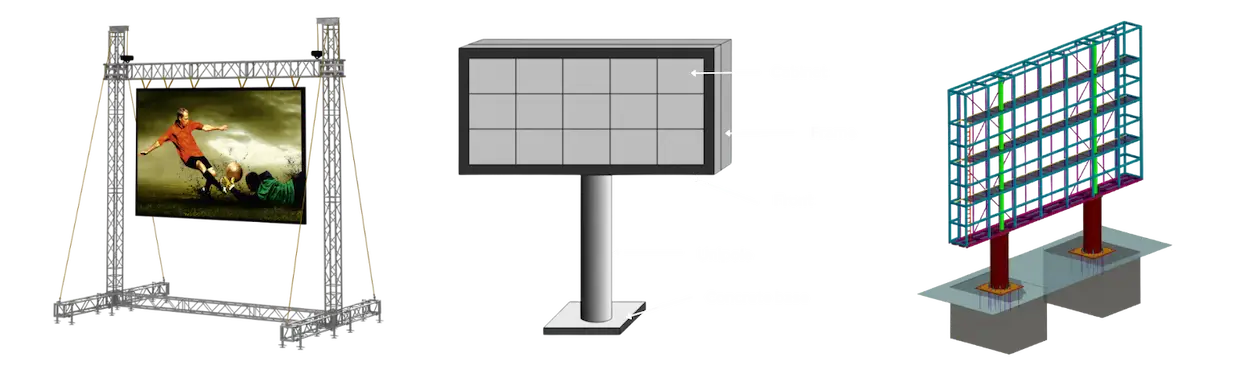
Installation location is a major factor in your pixel pitch decision. Consider:
- Indoor or outdoor placement
- Mounting type — wall, roof, poles, hanging displays, or banner kiosks
Brightness relative to surroundings matters most. Your screen’s brightness needs to exceed the ambient light level around it, or the content simply won’t be visible.
Outdoor screens have additional requirements. They need weatherproofing (typically IP65-rated for rain protection) and corrosion resistance to withstand harsh weather and direct sunlight exposure over time.
Key Factors to Consider When Choosing an LED Screen
LED Screens come in different Pixel resolutions, brightness levels, colors, and features, and each choice affects the quality, efficiency, and effectiveness of the visuals displayed on them. The right LED screen should match the needs and goals of the user, fit the location and environment, and provide clear, vivid, and reliable images or videos.
This guide provides useful tips, factors, and considerations, such as the viewing distance, angle, and height, the ambient light levels, the content types and formats, the maintenance requirements, and the budget limitations.
By following this guide, users can avoid common mistakes, such as overspending on unnecessary features, underestimating the technical requirements, or compromising on quality or safety standards.
If you want to display advertising messages in a crowded area, a larger screen will be more visible. If the LED screen is for indoor use, you may want to consider a smaller size.
Choosing the appropriate LED display size requires careful consideration of several factors depending on your specific needs and application. Here are some tips to help you choose the right LED display size:
Viewing distance
The viewing distance is the most important factor in determining the appropriate LED display pixels. The larger the distance, the larger the screen size required. Smaller the Viewing distance, smaller the pixel pitches (Explained in detail after) required for Clear images & Videos.
Content
Consider the type of content that will be displayed on the LED screen. Different content types require different display sizes. For example, if the display will be showing simple text, then a smaller size display can be used. However, if the content consists of high-resolution images or videos, then a larger display size will be required.
Ambient Light Conditions
The ambient light conditions can also affect the choice of the LED display. If the installation is in a brighter surrounding, a high-brightness LED screen is required to ensure visibility.
Budget
The cost of the display size is another important factor to consider. Larger screen sizes and Smaller Pixel Pitches are more expensive compared to smaller displays and higher Pixel Pitches.
Space Availability
Consider the available space where the LED display will be installed. Make sure the size of the LED display fits the available area without overcrowding or making the area look awkward.
Deciding the Suitable Pixel Pitch for Your LED Screen
How to choose the optimal LED Screen Resolution? When there are more pixels on the LED screen display, the higher the image quality. Of course, the higher the number of pixels, the more expensive the LED Screen.
Therefore, it is necessary to find an ideal balance between good visibility and competitive price when buying LED Screens. Choose the suitable pixel pitch for the LED screen display according to the minimum viewing distance.
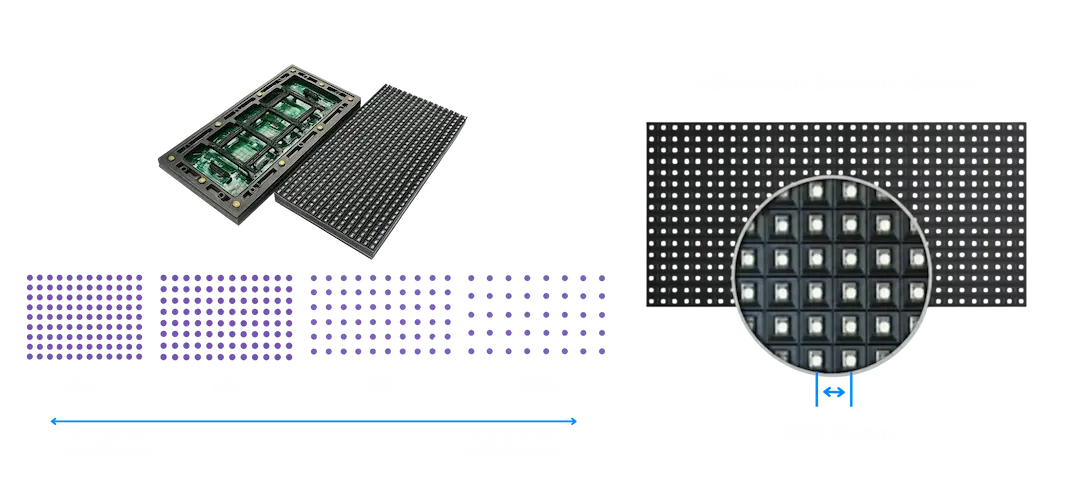
What is Pixel Pitch of LED Display? The Pixel Pitch means the center to center distance between two adjacent LED lamps in an LED Module or Screen.
Choosing the suitable pixel pitch for an LED screen display depends on several factors such as viewing distance, screen size, and content resolution. Here are some guidelines
to help you choose the right pixel pitch:
Choosing the suitable pixel pitch for an LED screen display depends on several factors such as viewing distance, screen size, and content resolution. Here are some guidelines to help you choose the right pixel pitch:
Viewing distance
Determine how far away the audience will be from the LED screen. The closer the audience is, the smaller the pixel pitch should be.
Content Resolution
The resolution of the content being displayed should match the native resolution of the LED screen. The pixel pitch should be chosen to achieve the desired resolution.
Budget
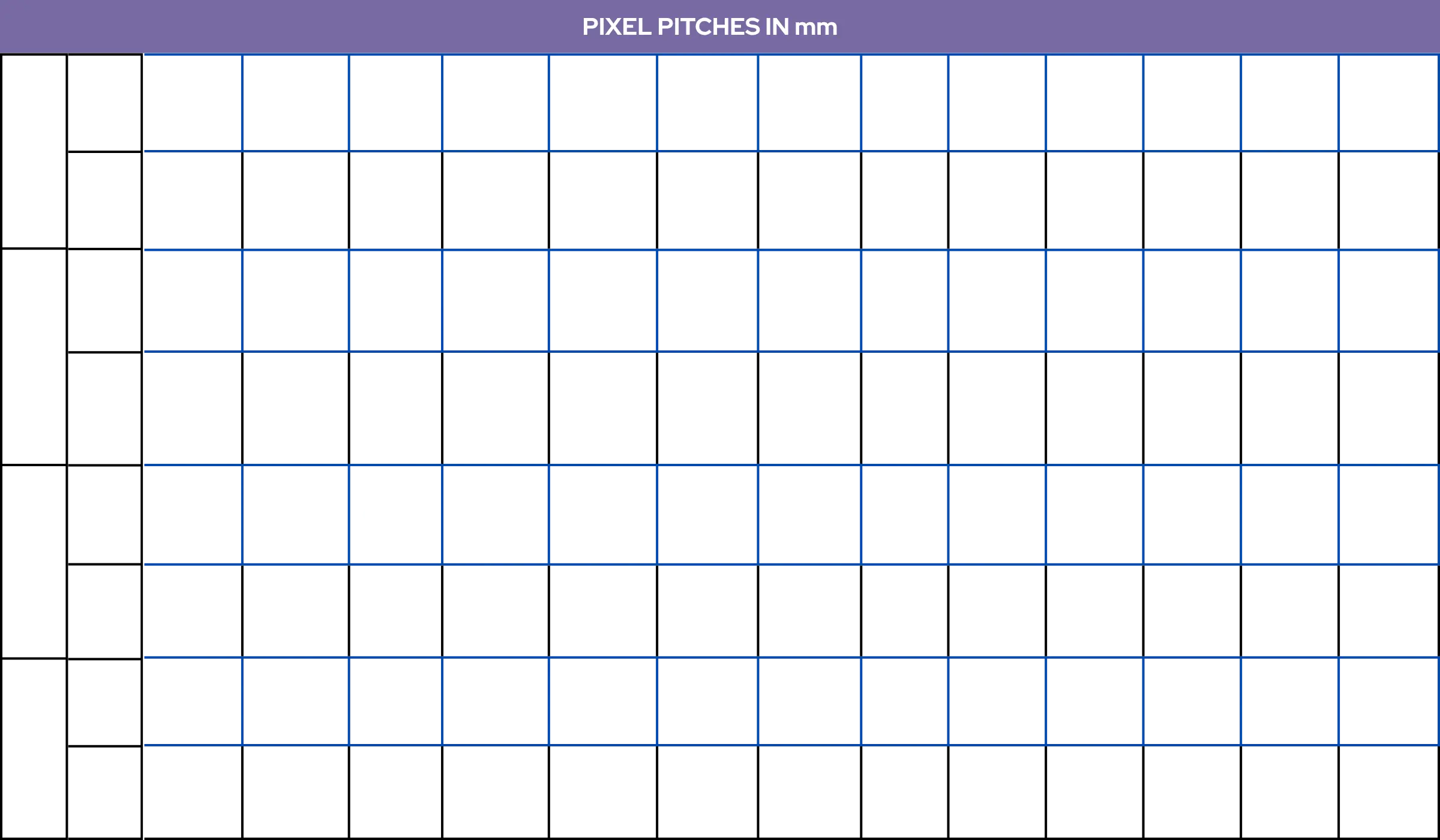
The cost of the screen will increase as the pixel pitch decreases. For outdoor LED displays, P4, P5 are generally used for short distances, and P6, P6.67, P8 or P10 for farther.
Outdoor LED displays:
- P4, P5 — best for shorter viewing distances.
- P6, P6.67, P8, P10 — better suited for greater viewing distances.
Indoor LED displays:
- P1.53, P1.86, P2,P2.5, P3.076 — ideal for close viewing.
- P4, P5 — suited to larger indoor spaces with greater viewing distance.
Rental LED screens (commonly used for events):
- Indoor: P1.9, P2.6, or P2.9
- Outdoor: P2.9, P3.9
Rule of thumb: Match your pixel pitch to your minimum viewing distance in meters. For example, a minimum viewing distance of 5 meters generally corresponds to a P5 pixel pitch.
For a precise recommendation tailored to your space, it’s best to consult a professional LED screen supplier.
Factors affecting in Choosing Suitable Brightness of LED Screens.
Factors affecting in Choosing Suitable Brightness of LED Screens
Environment
The brightness of the LED screen should match the ambient light of the environment where it is placed.
Distance
The brightness of the LED screen should depend on the viewing distance. For example, if the LED screen is placed farther away, a higher brightness level is required.
Content
The brightness also depends on the type of content to be displayed in the LED screen. For example, if it is a video or image with dark colors, a higher brightness level is needed.
Usually standard Indoor LED Screen brightness are 600 to 700nits (nits=Cd/Sqm) and Outdoors 4500-5000nits. Dgicon do customization 800 to 1200nits for Indoors 5500 to 10000nits depending on Pixels and Customer needs.
Different Pixel Options to Choose
Choosing the Right Brightness for Your LED Screen
Brightness (measured in nits, or candela per square meter) is a critical but often misunderstood spec. More brightness isn’t automatically better — the right brightness depends entirely on your environment.
- Too high → unnecessary energy consumption and cost
- Too low → content becomes unreadable in bright surroundings
Factors That Affect the Right Brightness Level
Environment — Brightness should match the ambient light level of the installation location.
Distance — Screens viewed from farther away typically need higher brightness to remain clearly visible.
Content — The type of content displayed can influence the optimal brightness setting, alongside pixel pitch and viewing conditions.
Typical Brightness Ranges
- Standard indoor LED screens: 600–700 nits.
- Standard outdoor LED screens: 4,500–5,000 nits.
- Dgicon custom indoor options: 800–1,200 nits.
- Dgicon custom outdoor options: 5,500–10,000 nits, depending on pixel pitch and specific client needs
Why Choose Dgicon for Your LED Screen?
Dgicon delivers customized LED screen solutions built around each client’s specific needs, backed by an experienced, highly skilled technical team. We maintain strict quality standards, provide timely maintenance support, and prioritize long-term client satisfaction over one-time sales.
Choosing the right LED screen can feel overwhelming at first — but with guidance from a genuine, professional supplier, it doesn’t have to be. Before making your final decision, make sure you’ve considered pixel pitch, size, brightness, and installation requirements.
Curious about the different display types available? See our guide on the types of LED screens to explore indoor, outdoor, transparent, flexible, and other display options.
DGICON is a reliable source to help you choose the right LED screen for your specific needs — don’t hesitate to contact us here.
